

You don’t need a gym membership or expensive equipment to start building strength. A resistance band workout for beginners can help you train your major muscle groups at home with a few lightweight, affordable bands.
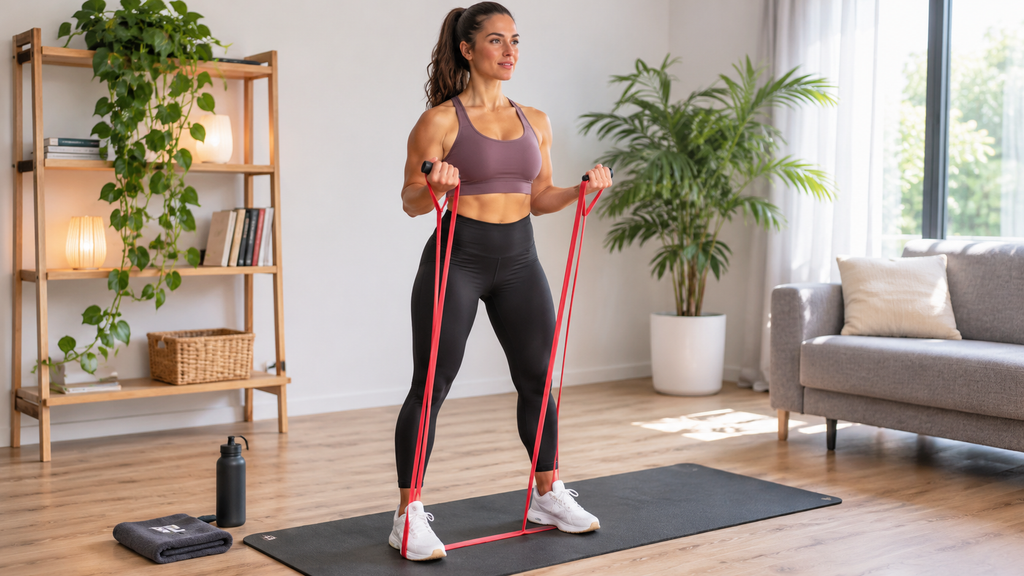
Resistance bands create tension as they stretch, allowing you to challenge your muscles through squats, rows, presses, and other familiar movements. They’re easy to store, convenient for travel, and adaptable to different fitness levels.
But knowing which exercises to perform—and how to organize them into a routine—can be confusing when you’re just getting started.
This guide walks you through seven beginner-friendly exercises, essential safety precautions, and a simple four-week training plan. You’ll learn how to choose the right resistance, practice good technique, and make gradual progress without rushing.
Why Resistance Bands Are Great for Beginners
Resistance bands offer a practical introduction to strength training, especially if you prefer exercising at home.
They’re convenient. Unlike bulky exercise machines, bands require very little storage space. You can use them in a living room, bedroom, or other clear workout area.
They’re versatile. Different exercises allow you to work your legs, back, chest, shoulders, and arms with the same basic type of equipment.
They offer adjustable resistance. You can change bands or modify the starting tension as you become stronger.
They’re relatively affordable. A small set of resistance bands generally requires less upfront spending than purchasing several pairs of dumbbells.
Most importantly, elastic resistance can be effective for improving strength.
A 2019 systematic review and meta-analysis examining eight studies found no statistically significant difference in strength improvements between elastic resistance and conventional resistance training in the studies analyzed. That doesn’t mean both methods are identical in every situation, but it supports resistance bands as a legitimate strength-training option.
If you prefer training without equipment, our Bodyweight Workout for Beginners offers another accessible starting point.
What You Need Before Your First Resistance Band Workout
For this program, you’ll use long loop resistance bands.
These are continuous elastic loops, sometimes called power bands. Ideally, choose a small set containing different resistance levels.
You won’t need a door anchor, exercise bench, or fixed attachment point.
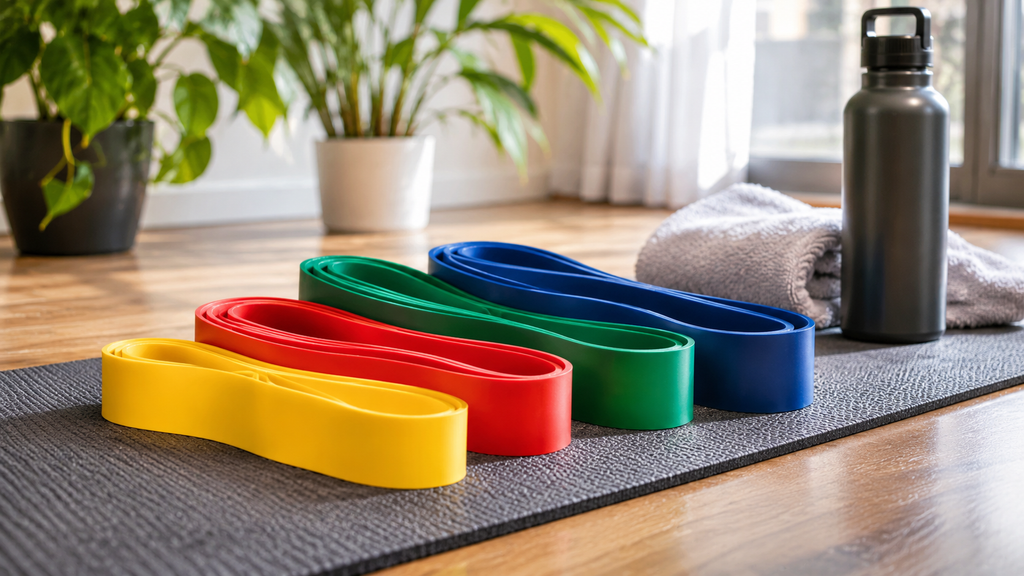
Long Loop Bands vs. Tube Bands
Long loop bands can be positioned under your feet, held in your hands, or placed around your upper back for certain exercises.
Tube bands usually have handles and may come with separate anchors. They can also be useful, but their setup differs from the movements described here.
Short mini bands, commonly used around the thighs or ankles, aren’t interchangeable with long loop bands for every exercise.
Using one clearly defined type of equipment makes this beginner program easier to follow.
How to Choose the Right Resistance
Start with a light band that allows smooth, controlled repetitions.
A suitable resistance should feel manageable at the beginning of a set and somewhat challenging toward the end, without forcing you to change your posture or use momentum.
Remember that different exercises require different amounts of resistance. A band that feels comfortable during squats may be too strong for shoulder movements.
Don’t rely on colors alone. Resistance levels and color systems vary between manufacturers.
Essential Resistance Band Safety Tips
Before every workout:
- Inspect bands for cracks, tears, thinning, or other damage.
- Replace bands showing signs of deterioration.
- Keep bands away from sharp edges and abrasive surfaces.
- Follow the manufacturer’s stretching and usage limits.
- Check that the band is secure before applying tension.
- Avoid positions where a slipping band could snap toward your face or eyes.
Never attach a band to furniture or fixtures that haven’t been designed and verified for that purpose.
The NHS Wales resistance band safety guidance specifically highlights the importance of inspecting equipment and preventing injuries caused by sudden band recoil.
If an exercise feels unstable, skip it rather than improvising.
Warm Up Before You Start
Spend approximately five minutes preparing for your workout.
Begin with comfortable marching in place for one or two minutes. Add gentle shoulder circles, controlled arm movements, and several bodyweight squats or sit-to-stand repetitions.
Then practice the first exercise without resistance.
Your warm-up should help you feel ready to move, not leave you exhausted.
If you’re returning after an injury, have a condition that affects exercise, or are unsure whether resistance training is appropriate for you, seek individualized advice from a qualified healthcare professional.
7 Resistance Band Exercises for Beginners
These seven movements provide a practical foundation for a full-body strength routine.
For your first week, aim for approximately 8–12 controlled repetitions per exercise, using fewer when necessary. Rest for 45–90 seconds between movements, or longer if needed.
You don’t have to complete every exercise immediately. Start with the movements you can perform comfortably and add others as your technique improves.
1. Resistance Band Squat
Main muscles: Quadriceps and glutes.
- Place the lower portion of a long loop band securely beneath both feet.
- Stand approximately shoulder-width apart.
- Hold the upper portion of the band in front of your shoulders, keeping it under control.
- Bend your hips and knees as if sitting back into a chair.
- Lower through a comfortable range, then push through your feet to stand.
Beginner target: 8–12 repetitions.
Keep your weight balanced and your knees moving generally in line with your toes. Avoid forcing a deeper squat than you can comfortably control.
Make sure the band remains securely beneath your feet.
Easier alternative: Perform bodyweight squats or sit-to-stand repetitions without a band.
2. Seated Resistance Band Row
Main muscles: Upper back and elbow-flexing muscles.
- Sit on the floor with your legs comfortably extended and knees slightly bent.
- Position the band securely around the soles of both feet.
- Hold the sides of the band with your hands.
- Sit upright and gently pull your elbows backward toward your torso.
- Slowly extend your arms to return to the starting position.
Beginner target: 8–12 repetitions.
Avoid rounding your back or jerking the band.
Safety reminder: Check the band’s position before every set. If it slips, shifts toward your toes, or cannot be held securely, stop. Don’t continue pulling against an unstable setup.
3. Resistance Band Chest Press
Main muscles: Chest, triceps, and front shoulders.
- Position a light long loop band behind your upper back, below shoulder level.
- Hold the sides securely in your hands, keeping the band away from your neck.
- Bring your hands near chest height with your elbows comfortably bent.
- Press forward in a smooth, controlled movement.
- Return slowly without allowing the band to snap back.
Beginner target: 8–12 repetitions.
Keep your wrists comfortable and avoid excessively arching your lower back.
If the band slides upward, pulls awkwardly, or feels unstable, stop.
Easier alternative: Wall push-ups provide a simple chest exercise without elastic resistance.
4. Resistance Band Romanian Deadlift
Main muscles: Glutes and hamstrings.
- Stand with both feet securely on the lower portion of the band.
- Hold the upper portion with both hands.
- Keep your knees slightly bent.
- Move your hips backward while keeping your spine in a comfortable, neutral position.
- Lower your hands along the front of your legs.
- Push your hips forward to return to standing.
Beginner target: 8–12 repetitions.
Think about moving your hips backward rather than bending forward from your waist.
You don’t need to reach the floor. Stop when you can no longer maintain a comfortable position.
Common mistake: Rounding your back to achieve a greater range of motion.
5. Resistance Band Biceps Curl
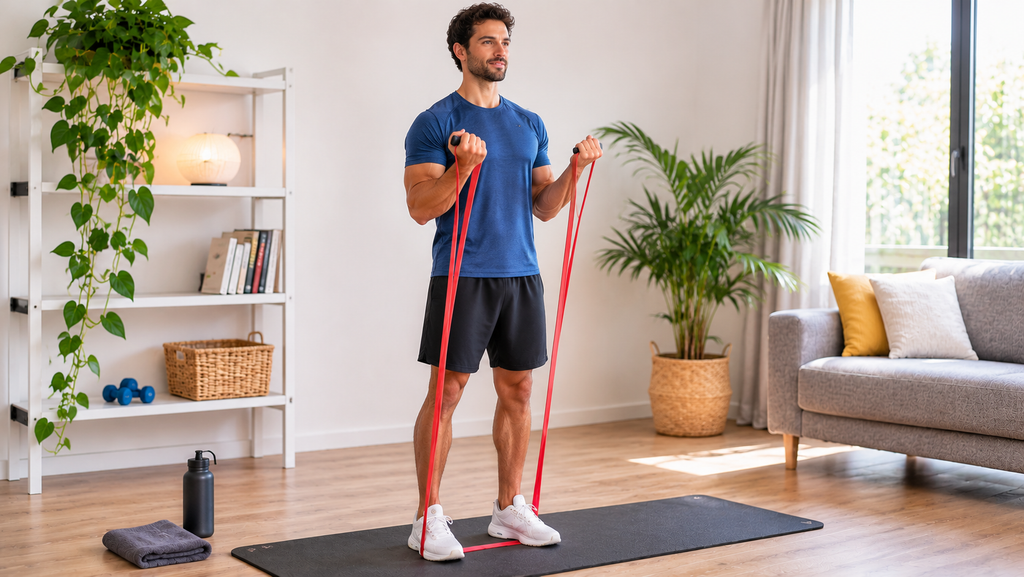
Main muscles: Biceps.
- Stand securely on the lower portion of the band.
- Hold the upper portion with your palms facing forward.
- Keep your elbows near your sides.
- Bend your elbows to raise your hands toward your shoulders.
- Lower your hands slowly and under control.
Beginner target: 8–12 repetitions.
Keep your torso relatively still. If you need to swing backward to lift the band, choose lighter resistance.
Focus on controlling both the lifting and lowering phases.
6. Resistance Band Overhead Press
Main muscles: Shoulders and triceps.
- Position a light band securely beneath both feet.
- Hold the upper portion near shoulder height.
- Stand tall with your knees relaxed and torso stable.
- Press upward through a comfortable range of motion.
- Lower slowly to the starting position.
Beginner target: 8–10 repetitions.
Use particularly light resistance for this exercise.
Avoid leaning backward or forcing your arms overhead if the movement feels restricted. Check that the band cannot slip from beneath your shoes.
Easier alternative: If you cannot perform the movement comfortably and securely, omit it for now. You can continue building upper-body strength with wall push-ups.
7. Resistance Band Pull-Apart
Main muscles: Upper back and rear shoulders.
- Hold a very light band in front of your chest with both hands.
- Keep your elbows slightly bent.
- Slowly move your hands apart through a comfortable range.
- Allow your shoulder blades to move naturally without shrugging.
- Return slowly to the starting position.
Beginner target: 8–12 repetitions.
Keep the band below face level and avoid stretching it excessively.
This movement can be difficult with a thick long loop band. If you don’t have a sufficiently light band, skip it rather than forcing the movement.
Remember: A safe, controlled exercise is more useful than completing a movement with unsuitable equipment.
Your 4-Week Beginner Resistance Band Workout Plan
Now that you know the exercises, let’s organize them into a manageable schedule.
This four-week plan is an introductory example, not a medically validated training protocol. Its purpose is to help you establish a routine and progress at a comfortable pace.
The CDC recommends muscle-strengthening activities on at least two days per week. Resistance bands are one way to meet that recommendation.
For this plan, train on Monday and Thursday, or choose any two nonconsecutive days that fit your schedule.
| Week | Sessions | Sets | Reps |
|---|---|---|---|
| 1 | 2 | 1 | 8–12 |
| 2 | 2 | 1–2 | 8–12 |
| 3 | 2 | Up to 2 | 8–12 |
| 4 | 2 | Up to 2 | 10–12 |
Week 1: Learn the Basics
Start with two workouts.
Perform one controlled set of each exercise you can complete safely. Use light resistance and take your time between movements.
If seven exercises feel overwhelming, begin with four or five and gradually introduce the others.
Your session may take around 20–30 minutes, including a warm-up.
The priority is learning—not exhaustion.
Week 2: Establish Consistency
Continue training twice.
If the first week felt manageable, consider adding a second set to one or two exercises.
Keep the remaining movements at one set if you need more time to develop confidence.
There’s no need to increase every exercise simultaneously.
Week 3: Improve Strength and Control
Aim for two sets of the movements you’ve mastered.
Pay attention to your technique, especially during the final repetitions.
If a band feels too strong, return to a lighter one. If a movement remains uncomfortable, continue with its easier alternative.
Maintain at least one recovery day between full-body sessions.
For more guidance on training frequency, read How Often Should Beginners Work Out?.
Week 4: Make Small Improvements
Continue with two workouts.
For exercises that feel comfortable, try increasing from eight repetitions toward twelve.
If you can already complete twelve controlled repetitions without excessive effort, a slightly stronger band may be appropriate for that particular exercise.
You don’t need to increase the difficulty of every movement.
Repeating an earlier week’s schedule is completely reasonable if you’re still developing technique or need more recovery.
How to Make Progress Without Overdoing It
Strength training relies partly on progressive overload—gradually increasing the challenge as your body adapts.
With resistance bands, you can do this by:
- Increasing repetitions while maintaining good technique.
- Adding a set when your current workload feels manageable.
- Choosing a slightly stronger band.
- Improving movement control and consistency.
For example, if you begin with eight controlled band squats and eventually complete twelve comfortably, you may be ready for a small increase in resistance.
Change one variable at a time.
Don’t judge a workout solely by how sore you feel afterward. Muscle soreness isn’t required for progress.
Stop exercising if you experience sharp pain, dizziness, or unusual symptoms. Seek medical advice when appropriate.
Learn more in our guide to Progressive Overload for Beginners.
Common Resistance Band Workout Mistakes
Avoiding a few common mistakes can make your workouts more effective and manageable.
Using a band that’s too strong. Excessive resistance often leads to jerky movements and poor technique. Start lighter than you think you need.
Rushing repetitions. Move deliberately, particularly as the band returns to its starting length.
Ignoring damaged equipment. Even a small tear can weaken a band. Inspect it before every session.
Allowing bands to slip. Check foot placement, hand position, and band alignment before applying tension.
Skipping recovery. Muscles need time to recover from challenging training. More sessions aren’t automatically better.
Trying to progress too quickly. A stronger band isn’t always the right next step. Sometimes better control or a few additional repetitions are enough.
The goal is steady improvement, not maximum difficulty.
Frequently Asked Questions
Can beginners build muscle with resistance bands?
Yes. Resistance bands can provide enough resistance to challenge muscles and support strength development. Results depend on training effort, consistency, nutrition, recovery, and gradually increasing the challenge when appropriate.
How often should beginners use resistance bands?
Two nonconsecutive full-body workouts per week are a practical starting point. This fits general recommendations to perform muscle-strengthening activities at least twice weekly. You can adjust your schedule as your fitness and recovery improve.
How long should a resistance band workout last?
A beginner workout may take approximately 20–35 minutes, including a warm-up and rest periods. The exact duration depends on the number of exercises, sets, and breaks. Focus on quality rather than reaching a particular time.
Are resistance bands enough for a full-body workout?
Resistance bands can challenge major muscle groups throughout the body when you choose suitable exercises and resistance levels. However, no single piece of equipment is necessary for everyone, and activities such as walking can complement strength training.
If you’re looking for an easy way to combine movement and exercise, explore our Walking Workout Plan for Beginners.
Final Thoughts
Starting strength training doesn’t have to be complicated.
A resistance band workout for beginners offers a flexible way to practice essential movements, build confidence, and establish a consistent exercise habit at home.
Begin with manageable resistance, prioritize technique, and follow the four-week plan at your own pace. If you need additional practice, repeat a week before increasing the difficulty.
The best beginner workout isn’t the hardest one. It’s a routine you can perform safely, consistently, and with gradual progress.
Not sure whether resistance bands are the right choice for you? Explore our Bodyweight vs Resistance Bands for Beginners comparison to discover which training method best fits your goals, experience, and home workout routine.
Sources and Further Reading
- Lopes et al. (2019) — Effects of Training With Elastic Resistance Versus Conventional Resistance on Muscular Strength: A Systematic Review and Meta-Analysis.
- CDC — What Counts as Physical Activity for Adults.
- American Heart Association — Strength and Resistance Training Exercise.
- NHS Wales — Safety Advice When Exercising With Resistance Bands or Tubing.