

Starting a bodyweight workout for beginners can feel more complicated than it needs to be. You may think you need a gym membership, expensive equipment, or a detailed training program before you can make progress.
You don’t.
A simple bodyweight workout for beginners can help you start building strength, improve your fitness, and develop a consistent exercise habit using mostly your own body weight.
Bodyweight exercises are especially useful when you’re new to strength training because many movements can be adjusted to your current ability. You can make an exercise easier while you learn proper technique, then gradually increase the challenge as you get stronger.
This beginner-friendly routine focuses on the major movement patterns and muscle groups while keeping the workout manageable. You can do it at home, and you don’t need a collection of fitness equipment to get started.
Bodyweight Workout for Beginners at a Glance
Start with two workouts per week on nonconsecutive days. Focus on controlled movement rather than trying to complete every repetition as quickly as possible.
| Exercise | Sets | Reps |
|---|---|---|
| Bodyweight or Chair Squat | 2 | 8–12 |
| Incline Push-Up | 2 | 6–10 |
| Glute Bridge | 2 | 10–15 |
| Supported Reverse Lunge | 2 | 6–10 per side |
| Backpack Row | 2 | 8–12 |
| Bird Dog | 2 | 6–10 per side |
Rest approximately 60–90 seconds between sets when needed.
These numbers are a starting point, not a test you have to pass. If eight squats with good form are challenging, eight is enough. If an exercise feels too difficult to perform with control, use an easier variation.
The goal during your first few weeks is simple: learn the movements and establish consistency.
Why Bodyweight Training Is a Good Starting Point
Bodyweight training is a form of resistance exercise in which your body provides much or all of the resistance.
Squats, push-ups, lunges, bridges, and similar movements can therefore be used to train strength without relying on traditional gym machines.
This is more than a convenient alternative to a gym. The American College of Sports Medicine’s 2026 resistance-training guidance notes that bodyweight exercises, elastic bands, and home-based training can all be effective options for improving strength and physical function.
For beginners, bodyweight training also offers several practical advantages.
You Can Start at Home
Removing the trip to the gym makes exercise easier to fit into a busy schedule. A small amount of open floor space is enough for most of this routine.
That matters because a workout program only works when you can follow it consistently.
Exercises Can Be Adjusted to Your Level
A standard floor push-up may be too difficult when you are just beginning. Instead of abandoning the exercise, you can perform an incline push-up against a stable elevated surface.
As you become stronger, you can gradually lower the incline.
The same principle applies to many bodyweight exercises. You don’t need to begin with the hardest version.
It Builds a Foundation for Future Training
Learning basic movement patterns now can make it easier to progress later to dumbbells, resistance bands, gym equipment, or more challenging bodyweight exercises.
Think of this routine as a starting point rather than a permanent limit.
Warm Up Before Your Bodyweight Workout
You don’t need an elaborate warm-up, but spending five to ten minutes preparing your body for exercise is a sensible habit.
Start with easy movement to gradually increase your activity level. You might walk around the house or march in place for a few minutes.
Then perform a few controlled movements similar to those in the workout, such as:
- Easy bodyweight squats
- Arm circles
- Hip hinges
- Alternating knee raises
- Gentle reverse lunges while holding a stable support
The warm-up should leave you feeling ready to exercise, not exhausted.
Save your energy for the actual workout.
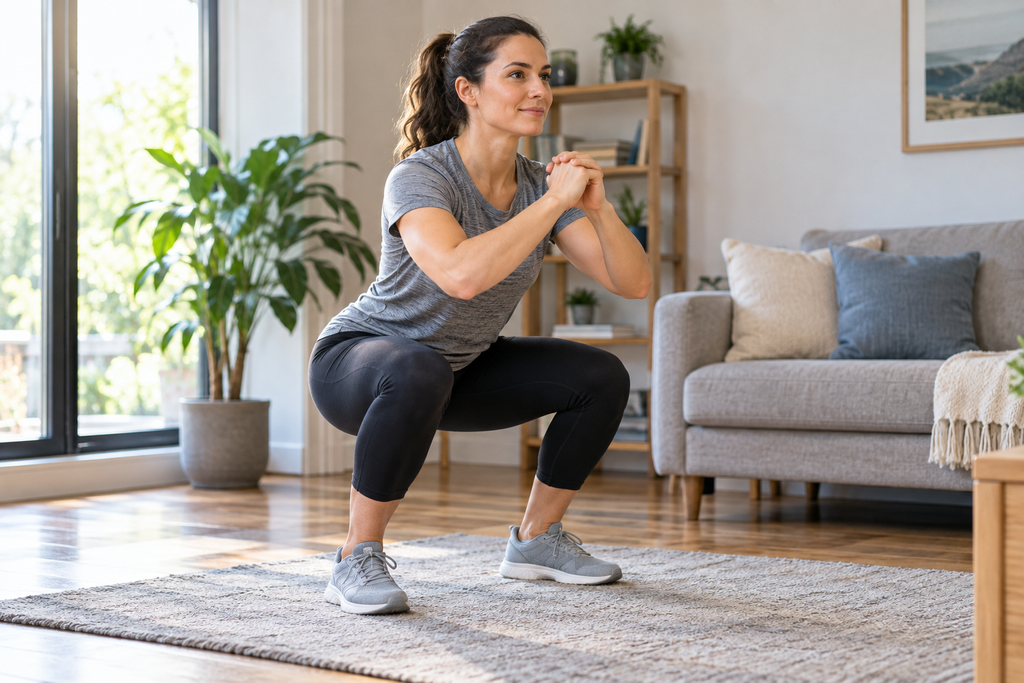
1. Bodyweight or Chair Squat
The squat trains several major muscles of the lower body and teaches a fundamental movement pattern you use in everyday life.
Stand with your feet in a comfortable position, usually around shoulder-width apart. Keep your torso controlled as you bend your knees and hips and lower yourself toward the floor.
Push through your feet to return to standing.
Aim for 2 sets of 8–12 repetitions.
If a regular bodyweight squat feels difficult, place a sturdy chair behind you and practice lowering yourself toward the seat before standing again.
Don’t worry about achieving an extremely deep squat. Use a range of motion you can control comfortably and build from there.
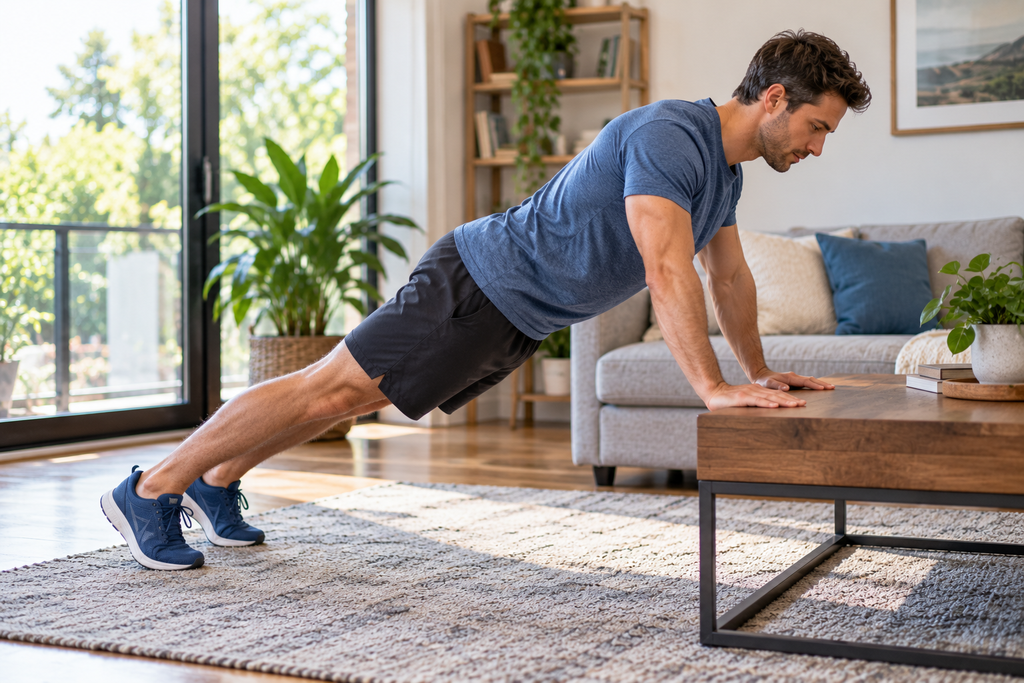
2. Incline Push-Up
Push-ups train the chest, shoulders, triceps, and core, but traditional floor push-ups can be challenging for beginners.
An incline changes the difficulty.
Place your hands on a stable elevated surface. Your body should form a relatively straight line from your head through your hips as you bend your elbows and lower your chest toward the surface.
Push yourself back to the starting position.
Complete 2 sets of 6–10 repetitions.
A higher surface generally makes the movement easier. As you gain strength, use progressively lower surfaces until you are ready to work toward a floor push-up.
Avoid using unstable furniture that could slide or tip while you exercise.
3. Glute Bridge
The glute bridge primarily trains the glutes while also involving muscles around the hips and trunk.
Lie on your back with your knees bent and feet on the floor.
Brace gently through your midsection and press through your feet as you lift your hips. Pause briefly near the top, then lower yourself with control.
Perform 2 sets of 10–15 repetitions.
Try not to turn the exercise into a competition to lift your hips as high as possible. Focus instead on a comfortable range of motion and controlled repetitions.
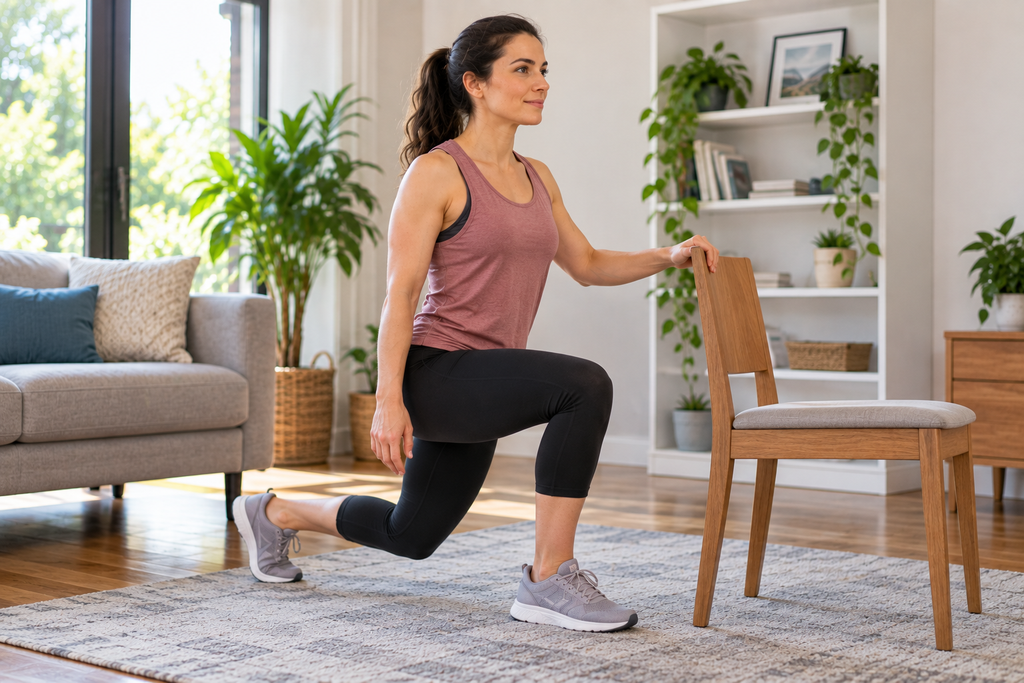
4. Supported Reverse Lunge
Lunges train the lower body one side at a time and also challenge balance and coordination.
For beginners, using support can make the exercise much more approachable.
Stand beside a stable surface that you can lightly hold for balance. Step one foot backward and lower yourself under control, then push through the front foot to return to standing.
Perform 2 sets of 6–10 repetitions on each side.
If reverse lunges are currently uncomfortable or too difficult to control, use a supported split squat instead. Start in a staggered stance and move vertically without stepping backward on every repetition.
There is no reason to rush to the harder version.
5. Backpack Row
One limitation of completely equipment-free workouts is that pulling movements are harder to reproduce safely at home.
That’s why this routine uses a simple household object instead of pretending every movement requires absolutely nothing.
Put a small amount of weight in a sturdy backpack. Start light.
With your back controlled and your hips pushed slightly backward, pull the backpack toward your torso, then lower it slowly.
Perform 2 sets of 8–12 repetitions.
You can gradually add resistance as the exercise becomes easier, provided the backpack is secure and you can maintain good technique.
If you already own a resistance band, a properly performed band row is another useful option.
6. Bird Dog
The bird dog trains trunk control while requiring your arms and legs to move around a relatively stable torso.
Start on your hands and knees.
Slowly extend one arm and the opposite leg. Pause briefly, return with control, and repeat on the other side.
Aim for 2 sets of 6–10 controlled repetitions per side.
Avoid trying to lift your arm or leg as high as possible. The objective is to maintain control rather than create a large range of motion.
Move slowly enough that you can feel whether your torso is rotating or shifting.
How Often Should You Do This Bodyweight Workout for Beginners?
For most healthy adults starting strength training, two nonconsecutive sessions per week is a reasonable starting schedule.
For example:
| Day | Activity |
|---|---|
| Monday | Bodyweight workout |
| Tuesday | Walking or light activity |
| Wednesday | Rest or light activity |
| Thursday | Bodyweight workout |
| Friday | Walking or light activity |
| Saturday | Optional recreational activity |
| Sunday | Rest |
Current U.S. physical activity guidance recommends that adults perform muscle-strengthening activities involving the major muscle groups on at least two days each week.
That does not mean you need to train every day to see benefits.
In fact, doing too much too soon can make a new routine unnecessarily difficult to maintain.
If you enjoy walking on days between strength workouts, it can be a simple way to stay active without repeating the same resistance session. Our guide to the benefits of walking 30 minutes every day explains why walking can be a useful addition to an active lifestyle.
If you want help organizing your strength workouts, cardio, and recovery days, see our guide on how often beginners should work out for a simple weekly schedule.
How Hard Should the Workout Feel?
A beginner workout should challenge you, but every set does not need to leave you completely exhausted.
Choose an exercise variation that allows you to perform your repetitions with reasonable control.
If your target is 8–12 squats and you could easily perform many more than 12, it may eventually be time to make the movement more challenging.
If you cannot reach the lower end of the range without your technique breaking down, use an easier variation.
This creates a simple feedback system:
Too difficult → make the exercise easier.
Appropriate challenge → continue practicing it.
Consistently too easy → progress gradually.
You don’t need to train to complete muscular failure on every set. The 2026 ACSM resistance-training update emphasizes that complicated or extreme methods are not necessary for the average healthy adult to make progress.
How to Progress Your Bodyweight Workout for Beginners
Doing exactly the same easy workout forever is unlikely to keep challenging your body.
As you become stronger, gradually increase the difficulty.
This approach is known as progressive overload, and it can help beginners continue building strength as exercises become easier.
But change one thing at a time.
Add Repetitions
Suppose you begin with 8 squats per set.
Over time, you might progress to 9, then 10, and eventually 12 controlled repetitions.
Once the top of the range becomes comfortable, you can consider another progression.
Use a More Challenging Variation
For incline push-ups, this might mean using a slightly lower stable surface.
For supported lunges, you may gradually rely less on the support as your balance and control improve.
Progress does not have to involve dramatic changes.
Add Resistance When Appropriate
Some movements eventually become easier to progress with external resistance.
A backpack, resistance band, or pair of dumbbells can expand your exercise options once you are ready.
You are still following the same basic principle: make the exercise gradually more challenging as your ability improves.
Add a Set
Beginners can start with two sets.
After you have trained consistently and the workout feels manageable, adding a third set to some exercises is another way to increase training volume.
There is no need to add repetitions, resistance, harder variations, and extra sets simultaneously.
Common Bodyweight Workout Mistakes for Beginners
Doing Too Much Too Soon
Motivation is useful, but doubling your workout volume during the first week does not necessarily help you establish a sustainable habit.
Start with an amount you can realistically repeat.
Consistency over months matters far more than making your first workout unnecessarily difficult.
Rushing Through Repetitions
Faster is not automatically better.
Controlled repetitions give you more opportunity to learn the movement and notice when your technique begins to change.
Comparing Yourself With Other People
Two beginners can have completely different starting points because of previous activity, age, mobility, strength, injuries, and many other factors.
Your useful comparison is with your own previous performance.
Ignoring Recovery
Strength training is only one part of an active lifestyle.
Sleep, nutrition, hydration, and time between challenging sessions all matter. If getting enough quality rest is a challenge, these science-backed tips to improve sleep naturally can help you build better sleep habits.
You also don’t need to remain completely inactive on recovery days. Walking and other comfortable activities can fit between strength workouts.
If hydration is something you are trying to improve, see our guide on how much water you should drink every day for a practical overview.
Constantly Changing Your Routine
Beginners often assume that every workout needs new exercises.
It doesn’t.
Repeating the same basic movements for several weeks makes it easier to practice technique and see whether you are progressing.
Variety can come later.
What If You Can’t Complete the Beginner Workout?
Shorten it.
A smaller workout you can perform safely is more useful than abandoning exercise because the full routine feels overwhelming.
You might begin with one set of each movement rather than two, or choose only a few exercises while learning the basic technique.
The Physical Activity Guidelines emphasize that people who are inactive can begin with smaller amounts of activity and gradually increase over time.
Your first objective is not to prove how fit you are.
It is to create a routine that gives you somewhere to progress from.
When to Get Professional Guidance
This article is intended as general fitness information for healthy adults, not individualized medical or rehabilitation advice.
If you have a chronic medical condition, disability, significant pain, an injury, or concerns about whether a particular exercise is appropriate for you, speak with a qualified healthcare professional or appropriately credentialed exercise professional.
Stop an exercise if it causes sharp or unusual pain.
Exercise can be challenging without feeling wrong. Learning the difference becomes easier with experience, but persistent or concerning symptoms should not simply be trained through.
The Bottom Line
You don’t need a complicated program to begin strength training.
This bodyweight workout for beginners gives you a simple starting structure: six movements, two sets each, and two workouts per week.
Learn the exercises first. Build consistency. Then gradually add repetitions, use more challenging variations, or introduce additional resistance as you become stronger.
The most effective beginner routine is not necessarily the most advanced one.
It is one you can perform safely, progress gradually, and continue doing.
Frequently Asked Questions
Is a bodyweight workout enough for beginners?
Bodyweight exercises can provide meaningful resistance for beginners, especially when exercises are selected and progressed appropriately. Current ACSM guidance recognizes bodyweight and home-based resistance training as effective options. As you become stronger, harder variations or external resistance can help you continue progressing.
How long should a bodyweight workout for beginners take?
There is no required duration. This six-exercise routine may take roughly 20–35 minutes depending on your rest periods, pace, and number of sets. Focus more on performing controlled repetitions than finishing within a specific time.
How many days a week should a beginner do bodyweight exercises?
Two nonconsecutive full-body sessions per week are a practical starting point. U.S. physical activity guidelines recommend muscle-strengthening activity involving the major muscle groups on at least two days each week.
Can I do bodyweight workouts every day?
You do not need to perform the same full-body strength workout every day. Beginners can leave recovery time between challenging sessions and use other days for walking or comfortable physical activity.
Can you build muscle with bodyweight exercises?
Bodyweight exercises provide resistance and can contribute to increases in strength and muscle when they are sufficiently challenging and progressively adjusted. As exercises become easy, increasing their difficulty or adding external resistance can help maintain an appropriate training stimulus.