

When you first start strength training, progressive overload probably isn’t the first thing on your mind. Almost everything already feels challenging.
Then something changes.
After a few weeks of consistent training, the same exercises start to feel easier. You can perform more repetitions, your movements feel more controlled, and the workout that once challenged you may no longer feel quite as demanding.
That is a good thing. It means your body is adapting.
But if you want to continue getting stronger, your training eventually needs to progress too.
This is the basic idea behind progressive overload for beginners: gradually increasing the challenge of your workouts as your body becomes capable of doing more.
You do not need to add weight every workout, train to failure, or follow complicated formulas. You simply need a sensible way to make your exercises more challenging over time.
Here is how to do it.
What Is Progressive Overload?
Progressive overload means gradually increasing the demands you place on your body during training.
Imagine that you start doing goblet squats with a 20-pound dumbbell. During your first workout, 8 repetitions feel challenging.
After several weeks, you can perform 12 repetitions with good form and much less difficulty.
Your body has adapted to the original challenge.
Instead of repeating exactly the same workout indefinitely, you could now increase the resistance slightly, perform more repetitions, add another set, improve your range of motion, or make the exercise more difficult in another way.
That gradual increase in challenge is progressive overload.
The principle is important because resistance training works by giving your muscles a reason to adapt. The American College of Sports Medicine’s updated 2026 Position Stand concluded that resistance training improves muscular strength, muscle size, power, endurance, and physical function in healthy adults.
Progressive overload simply helps the challenge continue to evolve as your abilities improve.
Why Progressive Overload Matters for Beginners
Beginners often make progress quickly when they start strength training.
You are learning new movements, improving coordination, developing strength, and becoming more comfortable with exercises that previously felt unfamiliar.
But your body is also becoming better at handling the workload.
If you perform the exact same exercises with the exact same resistance, repetitions, sets, and difficulty for months, those workouts may eventually provide less of a challenge.
That does not mean you need to constantly redesign your routine.
In fact, changing exercises too frequently can make progress harder to track.
Instead, progressive overload gives you a simple framework:
Keep practicing the important movements, and gradually make them more challenging when you are ready.
For a beginner, this approach can help you continue building strength without turning every workout into a test of your limits.
6 Ways to Apply Progressive Overload
Adding more weight is only one form of progressive overload.
This is especially important for beginners because you may be training at home, using limited equipment, or still learning proper exercise technique.
Here are six practical ways to progress.
1. Add More Repetitions
Adding repetitions is one of the easiest ways to apply progressive overload.
Suppose you are doing 2 sets of 8 squats.
As you get stronger, you might progress to:
2 sets of 9 reps
then:
2 sets of 10 reps
You are using the same exercise and resistance, but your muscles are performing more work.
This method works especially well when you use a target rep range, such as 8–12 repetitions.
Instead of increasing the weight immediately, you gradually work toward the upper end of that range.
2. Increase the Weight or Resistance
Once you can perform your target repetitions with good technique, you may be ready to increase resistance.
For example:
20-pound goblet squat → 25-pound goblet squat
or:
15-pound dumbbell row → 20-pound dumbbell row
The increase does not need to be large.
Earlier ACSM progression guidance suggested increasing resistance by approximately 2% to 10% when someone could perform one or two repetitions beyond the desired target. This can be a useful reference, but beginners do not need to calculate exact percentages every time they train.
The practical rule is simpler:
Increase resistance in small, manageable steps that still allow you to perform the exercise with good technique.
3. Add Another Set
Another way to increase training volume is to add a set.
For example:
2 sets of 10 squats
could eventually become:
3 sets of 10 squats.
This can significantly increase the amount of work you perform, so it does not need to happen frequently.
If you are already making progress with your current number of sets, there is no reason to keep adding more just because you can.
More training is useful only when you can recover from it.
4. Improve Your Range of Motion
Progress is not always represented by a bigger number.
Imagine that you can perform 10 squats, but they are shallow and inconsistent.
Several weeks later, you can perform the same 10 repetitions through a comfortable, fuller range of motion while maintaining good control.
You may not have increased the weight or repetitions, but the exercise has become more demanding and your movement quality has improved.
For beginners, improving technique and range of motion can be a better progression than rushing to add resistance.
5. Slow Down the Movement
You can also make some exercises more challenging by performing them with greater control.
Instead of dropping quickly into a squat, for example, you might lower yourself slowly and deliberately before standing back up.
The same idea can work with push-ups, lunges, rows, and many other exercises.
Slowing a movement changes how the exercise feels and can increase the time your muscles spend working during each repetition.
However, slower is not automatically better.
The goal is not to make every repetition as slow as possible. Use controlled movement when it helps you maintain technique or create an appropriate challenge.
6. Use a Harder Exercise Variation
Exercise variations are particularly useful when you train without weights.
Consider push-ups.
You might progress from:
Wall push-up → incline push-up → regular push-up → feet-elevated push-up
Each variation changes the difficulty without requiring you to add a dumbbell or weight plate.
The same idea can be applied to many bodyweight exercises.
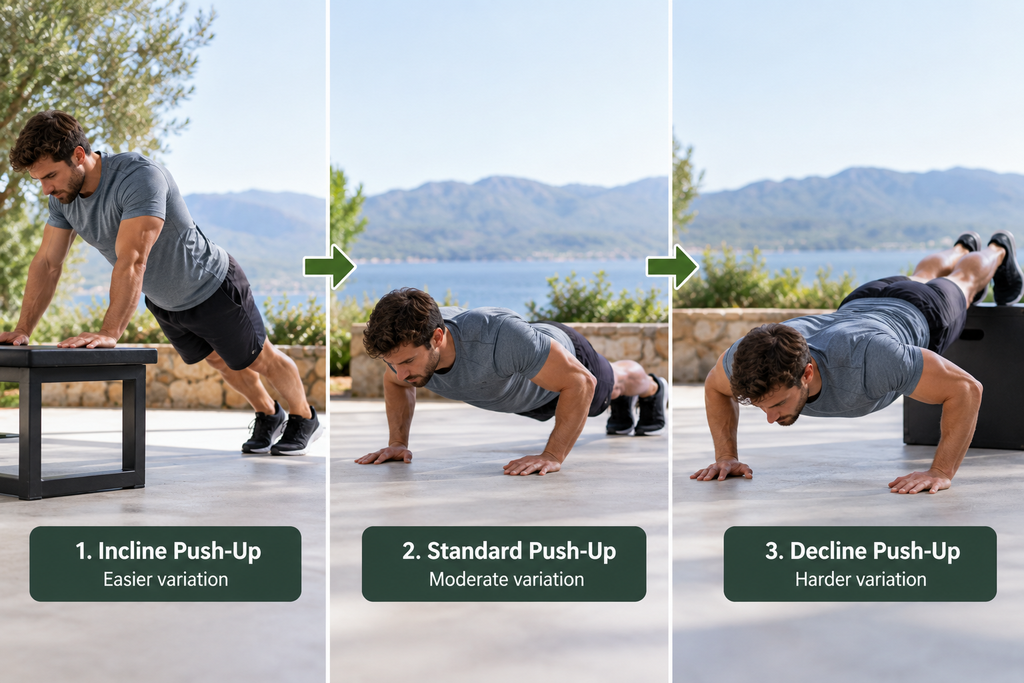
The important part is choosing a progression that is only moderately harder than what you can currently perform.
Progressive Overload Without Weights
You do not need a gym or a rack full of dumbbells to use progressive overload.
Bodyweight exercises can be progressed in several ways.
You can:
- perform more repetitions
- add a set
- improve your range of motion
- slow down part of the movement
- add a controlled pause
- move to a more difficult variation
Suppose you are currently performing incline push-ups with your hands on a sturdy elevated surface.
At first, you might manage 6 controlled repetitions.
Over time, you progress to 8, then 10, then 12.
Once that variation becomes consistently manageable, you could use a slightly lower surface. Eventually, you may progress to regular floor push-ups.
You are still applying progressive overload even though you never added external weight.
If you are just starting strength training at home, our beginner bodyweight workout provides a simple full-body routine that you can gradually progress using these methods.
A Simple Progressive Overload Example for Beginners
One of the easiest progression systems for beginners is sometimes called double progression.
Instead of trying to add weight every week, you choose a repetition range and gradually increase your repetitions first.
Suppose your target is 3 sets of 8–12 goblet squats.
Your progression might look like this:
| Week | Exercise | Sets | Reps | Next Step |
|---|---|---|---|---|
| 1 | Goblet Squat | 3 | 8 | Keep the same weight |
| 2 | Goblet Squat | 3 | 10 | Keep progressing |
| 3 | Goblet Squat | 3 | 12 | Reach the top of the range |
| 4 | Goblet Squat | 3 | 8 | Increase weight slightly |
You first build your repetitions while keeping the resistance relatively stable.
Once you can reach the top of your target range with good technique, you increase the resistance slightly.
Your repetitions may then drop toward the lower end of the range.
That is expected.
You gradually build them back up and repeat the process.
This gives beginners a clear answer to an important question:
What should I change in my next workout?
Often, the answer is simply one more clean repetition — not a completely new routine.
How Often Should Beginners Increase Weight or Reps?
There is no rule saying you must increase your weight every week.
Some weeks you may improve.
Other weeks you may repeat exactly what you did before.
Both can be part of successful training.
Before increasing the difficulty, ask whether you can:
- perform the exercise with good technique
- complete your target repetitions
- control the movement
- recover adequately between workouts
- repeat your performance consistently
If the answer is yes and the current workload has become manageable, a small progression may be appropriate.
If you are struggling to complete your current target, adding more weight simply because another week has passed is unlikely to help.
Your overall training schedule matters too. The CDC recommends muscle-strengthening activity on at least two days per week for adults, while allowing recovery between sessions can help you train consistently.
If you are still deciding how to organize your week, our guide to how often beginners should work out explains how training frequency and recovery can fit together.
Progressive Overload vs. Doing More Every Workout
Progressive overload does not mean you must do more every single time you exercise.
That distinction matters.
Imagine that on Monday you increase your squat weight.
On Wednesday you add repetitions.
On Friday you add another set.
The following week you choose a harder variation.
You are certainly doing more, but you may also be changing too many variables too quickly.
Progressive overload should be gradual and sustainable.
Sometimes your next workout should look exactly like your previous workout.
Repeating a workload can give you another opportunity to practice technique, confirm that the previous performance was not a one-time result, and see whether the exercise feels more controlled.
You also do not need to push every set until you physically cannot complete another repetition.
Systematic reviews comparing resistance training to muscular failure with non-failure training have found that reaching failure is not required for improvements in strength or muscle growth.
Your workouts need to provide a meaningful challenge.
They do not need to become a maximum-effort test every time.
How to Track Progressive Overload
Progressive overload becomes much easier when you know what you did during your previous workout.
You do not need an advanced fitness tracker.
A notebook, your phone’s Notes app, or a simple spreadsheet can be enough.
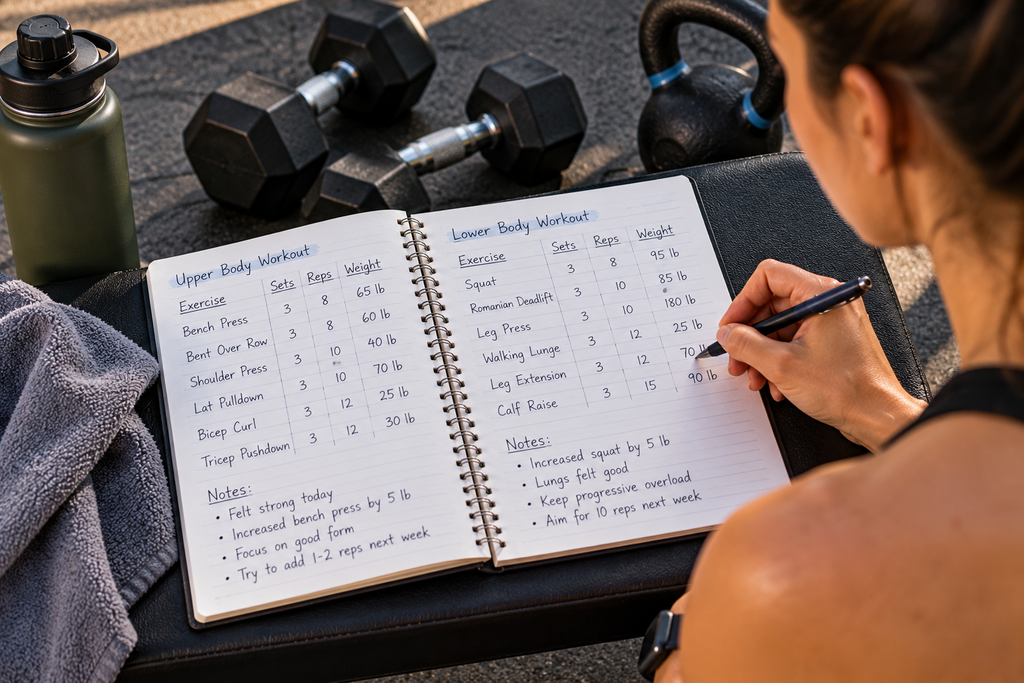
Record the exercise, resistance or variation, number of sets, repetitions, and any useful notes.
For example:
| Exercise | Weight/Variation | Sets | Reps | Notes |
|---|---|---|---|---|
| Squat | 20 lb | 3 | 10, 10, 9 | Good form |
| Push-Up | Bodyweight | 3 | 8, 8, 7 | Last reps difficult |
The next time you perform those exercises, you have a reference point.
Perhaps you complete 10 repetitions on all three squat sets.
That is progress.
Perhaps you repeat 10, 10, 9 but the movement feels more controlled.
That can still be useful information.
Do not judge your progress from a single workout.
Look for trends across several weeks.
Common Progressive Overload Mistakes
Increasing Weight Too Quickly
A heavier weight is not automatically an improvement.
If you can lift more only by shortening your range of motion, using momentum, or losing control, the increase may be too large.
Changing Too Many Variables at Once
Avoid simultaneously adding weight, repetitions, sets, and harder variations.
Changing one main variable at a time makes your progress easier to manage and track.
Sacrificing Form for Bigger Numbers
Your workout log should not become a competition with yourself.
An extra repetition is useful only if you can perform it with reasonable technique.
Adding Volume Without Enough Recovery
More sets mean more training.
If you keep increasing volume without giving yourself enough time to recover, your performance may eventually suffer.
Changing Exercises Constantly
Variety can make training enjoyable, but replacing exercises every workout makes it difficult to measure progress.
Keeping key movements consistent gives you something meaningful to compare over time.
Expecting Progress Every Workout
Progress is rarely perfectly linear.
You may improve for several sessions, stay at the same level for a while, and then improve again.
Look at the direction of your training over weeks and months rather than expecting a personal best every day.
Ignoring Persistent Pain
Muscle fatigue during exercise is different from persistent or unusual pain.
Do not use progressive overload as a reason to repeatedly push through pain.
When You Should NOT Progress Yet
Sometimes the best training decision is to keep the workload exactly where it is.
Consider waiting before increasing the difficulty if:
- your technique is getting worse
- you cannot complete the current target
- you have not recovered adequately
- your performance is consistently declining
- you are compensating or using momentum to finish repetitions
- you have persistent or unusual pain
Progressive overload is not about forcing improvement on a schedule.
It is about matching the challenge to your current ability.
If pain is persistent, severe, or concerning, stop the aggravating activity and consider speaking with an appropriate healthcare professional rather than simply trying to train harder.
A Simple Progressive Overload Plan for Beginners
You do not need complicated calculations to put everything together.
Try this simple process.
1. Choose a rep range.
For example, your program might call for 8–12 repetitions.
2. Keep the resistance consistent.
Choose a weight or exercise variation that allows you to complete the lower end of the range with controlled technique.
3. Gradually add clean reps.
Over subsequent workouts, try to improve your repetitions without sacrificing form.
You do not need to add reps every session.
4. Reach the top of the range.
Continue until you can perform the upper end of your target range across your prescribed sets with good control.
5. Increase resistance slightly.
Add a manageable amount of weight or move to a slightly harder exercise variation.
6. Return toward the lower end of the range.
The new resistance will be harder, so your repetitions will probably decrease.
That is normal.
7. Repeat.
Gradually build your repetitions again.
This simple cycle gives your training direction without requiring you to constantly change your workout.
Frequently Asked Questions
What is progressive overload in simple terms?
Progressive overload means gradually making your training more challenging as your body adapts. You can do this by adding repetitions, resistance, sets, range of motion, movement control, or harder exercise variations.
How should a beginner start progressive overload?
Start by choosing a manageable exercise and repetition range. Practice it consistently, improve your technique, and gradually add clean repetitions. Once you can comfortably reach the top of your target range, consider a small increase in resistance or exercise difficulty.
Do I need to increase weight every week?
No. Progressive overload does not require weekly weight increases. Increase resistance when your current workload has become consistently manageable and you can complete your target with good technique.
Can you use progressive overload without weights?
Yes. Bodyweight training can be progressed by adding repetitions or sets, increasing range of motion, slowing or pausing a movement, or moving to a harder exercise variation.
Should I add weight or reps first?
For many beginners, adding repetitions within a target range is a simple place to start. Once you reach the top of that range with good technique, you can slightly increase the resistance and build your repetitions again.
What happens if I don’t use progressive overload?
You may still benefit from regular physical activity, especially when you are new to exercise. However, if your goal is to continue improving strength or training capacity, repeating a workload that has become very easy may eventually provide less stimulus for further adaptation.
The Bottom Line
Progressive overload for beginners is much simpler than it sometimes sounds.
You do not need to add weight every workout.
You do not need to train to failure.
And you do not need to constantly replace your routine with something harder.
Start with exercises you can perform consistently. Track what you do. Improve your technique. Gradually add repetitions, resistance, sets, range of motion, control, or exercise difficulty when your current workload becomes manageable.
Then give yourself time to adapt again.
The goal is not to make every workout harder than the last.
The goal is to make your training gradually more challenging as you become capable of doing more.
That small distinction can turn a simple beginner routine into a training plan that continues to grow with you.
Sources
American College of Sports Medicine (ACSM) — Resistance Training Prescription for Muscle Function, Hypertrophy, and Physical Performance in Healthy Adults: An Overview of Reviews.
American College of Sports Medicine (ACSM) — Progression Models in Resistance Training for Healthy Adults.
Centers for Disease Control and Prevention (CDC) — Adult Activity: An Overview.
Grgic J, Schoenfeld BJ, Orazem J, Sabol F. — Effects of Resistance Training Performed to Repetition Failure or Non-Failure on Muscular Strength and Hypertrophy: A Systematic Review and Meta-Analysis.