

Starting a walking workout plan for beginners can be simple: put on your shoes, head outside, and start moving. But if you are new to exercise, a few questions usually come up quickly.
How long should you walk? How many days a week? How fast should you go? And when should you start doing more?
A structured walking plan can answer those questions without making exercise unnecessarily complicated.
Walking is one of the easiest ways to become more active because it requires little equipment, can be adjusted to almost any fitness level, and does not require a gym. The American Heart Association also recommends starting with short, manageable walks if you have been inactive and gradually increasing your time or distance.
This four-week walking workout plan for beginners starts with manageable sessions and gradually increases your walking time and intensity. You do not need to walk fast from day one, and you do not need to complete every workout perfectly.
The goal is simple: build a walking habit you can continue after the four weeks are over.
How Much Walking Should a Beginner Start With?
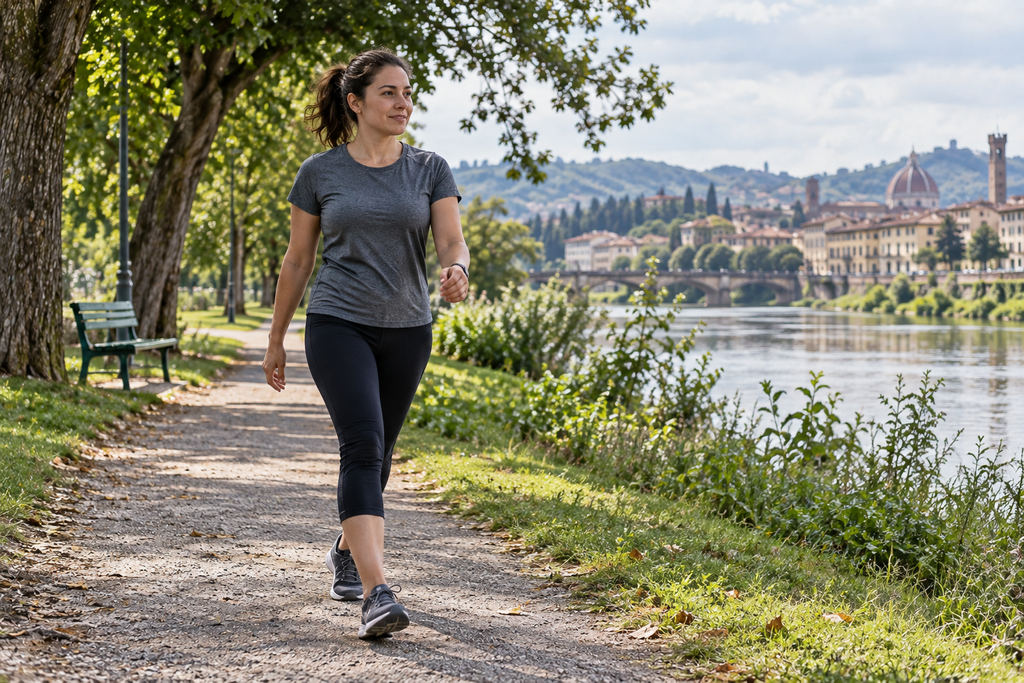
If you are completely new to regular exercise, you do not need to start with 30- or 60-minute walks.
A 10- to 15-minute walk can be a perfectly reasonable starting point.
The American College of Sports Medicine recommends that inactive people start with short distances or periods of about 10–15 minutes and gradually increase from there.
The American Heart Association similarly recommends beginning with short distances and gradually increasing your walking time or distance as your fitness improves.
Eventually, many adults can work toward the broader physical activity recommendation of at least 150 minutes of moderate-intensity aerobic activity per week, such as brisk walking. Adults are also advised to include muscle-strengthening activities on at least two days per week.
But 150 minutes is a long-term target, not a requirement for your first week.
If 10 minutes feels challenging today, start there.
Your 4-Week Walking Workout Plan for Beginners: The Schedule
This beginner walking plan gradually increases three things:
- Consistency: walking regularly throughout the week
- Duration: spending slightly more time walking
- Intensity: introducing controlled periods of brisker walking
You do not have to progress every week just because the calendar says so. If one week feels too difficult, repeat it before moving forward.
Here is the complete plan:
| Week | Walking Days | Main Walk Duration | Intensity | Main Goal |
|---|---|---|---|---|
| Week 1 | 3 days | 10–15 minutes | Easy | Build the habit |
| Week 2 | 4 days | 15–20 minutes | Easy to moderate | Add time |
| Week 3 | 4 days | 20–25 minutes | Easy + brisk intervals | Add intensity |
| Week 4 | 5 days | 25–30 minutes | Moderate | Build endurance |
The times in the table are guidelines rather than pass-or-fail targets. Adjust them according to your current fitness level.
Week 1: Build the Habit
Goal: Walk 3 days for 10–15 minutes.
Your first week is not about speed.
It is about proving that you can make walking part of your routine.
Choose three nonconsecutive or comfortably spaced days during the week. For example:
Monday — 10–15 minutes
Wednesday — 10–15 minutes
Saturday — 10–15 minutes
Walk at an easy, comfortable pace.
You should finish feeling like you probably could have done a little more.
Starting conservatively is especially useful if you have been sedentary for a long time. There is little benefit in turning your first walk into an exhausting workout that makes you dread the next one.
Try to walk somewhere convenient: around your neighborhood, in a park, on a treadmill, or even indoors when the weather is bad.
Consistency matters more than finding the perfect route.
Week 2: Add Walking Time
Goal: Walk 4 days for 15–20 minutes.
Now add one walking day and slightly increase the duration of your sessions.
For example:
Monday — 15 minutes
Wednesday — 15–20 minutes
Friday — 15 minutes
Sunday — 20 minutes
Keep most of these walks comfortable.
You may naturally notice that your normal walking pace starts to feel easier than it did during Week 1. That is a good sign. You do not need to force a faster pace yet.
If 20 minutes feels like too much, stay at 15 minutes for another week.
Progress does not have to happen according to an exact schedule.
Week 3: Introduce Brisk Walking
Goal: Walk 4 days for approximately 20–25 minutes and introduce short brisk intervals.
During two walks this week, try adding a few controlled periods at a faster pace.
For example:
5 minutes easy
2 minutes brisk
3 minutes easy
2 minutes brisk
3 minutes easy
2 minutes brisk
5 minutes easy
Do not turn the brisk sections into an all-out effort.
The goal is simply to walk fast enough that your breathing becomes noticeably stronger while remaining controlled.
On your other walking days, continue walking at a comfortable pace.

Intervals provide a simple way to increase the challenge without requiring you to walk faster for the entire workout. The American Heart Association also suggests alternating faster and slower walking periods as one way to gradually add challenge.
Week 4: Build Endurance
Goal: Walk 5 days for approximately 25–30 minutes.
By the fourth week, your schedule might look like this:
Monday — 25 minutes moderate
Tuesday — 25 minutes easy
Thursday — 30 minutes moderate
Saturday — 25 minutes with brisk intervals
Sunday — 30 minutes easy to moderate
Do not worry if you are not ready for five 30-minute walks.
Someone who started from very little activity may need longer than four weeks to reach that level, and that is completely reasonable.
Instead of treating Week 4 as a finish line, think of it as the beginning of a sustainable walking routine.
How Fast Should You Walk?
You do not need to measure your walking speed precisely.
One of the easiest ways to judge intensity is the talk test.
According to the CDC, during moderate-intensity activity you should generally be able to talk but not sing. At vigorous intensity, saying more than a few words without stopping for a breath becomes difficult.
For this beginner plan, think about your pace in three simple levels:
Easy: You can comfortably hold a conversation.
Moderate or brisk: You are breathing harder, but you can still talk.
Hard: Talking becomes difficult and you need frequent pauses for breath.
Most of your early walking should stay between easy and moderate.
There is no need to chase a specific miles-per-hour number because the same walking speed can feel very different depending on your age, fitness level, terrain, weather, and experience.
Relative effort is usually more useful for beginners.
How Often Should Beginners Walk?
Three or four walking workouts per week is a manageable starting point for many beginners.
As walking becomes easier, you can gradually increase your frequency.
Ultimately, adults are encouraged to accumulate at least 150 minutes of moderate-intensity aerobic activity per week, and those minutes can be spread throughout the week rather than completed in one long workout.
That does not mean every walk has to be a formal workout.
You might take a short walk after lunch, walk to a nearby store, or add another easy walk later in the day.
Short periods of activity still contribute to your overall movement. The American Heart Association notes that several shorter walks throughout the day can add up when a longer session is difficult to fit into your schedule.
If you are also doing other forms of exercise, your ideal walking frequency may be different.
For a broader look at planning your training week, read How Often Should Beginners Work Out? A Simple Weekly Schedule.
How to Progress Your Walking Workout Plan for Beginners
Once walking starts feeling easier, you need a way to keep making progress.
That does not mean turning every walk into a harder workout.
Instead, change one variable at a time.
1. Increase Your Walking Time
This is usually the simplest place to start.
A 15-minute walk might become 20 minutes. Later, 20 minutes might become 25.
Small increases are easier to manage than suddenly doubling your walking time.
2. Add Another Walking Day
If you currently walk three times per week, you might eventually add a fourth day.
Keep the additional walk easy at first.
More is not automatically better. Add frequency only when your current schedule feels manageable and you are recovering well.
3. Increase Your Pace
Once you can comfortably complete your planned walking time, make parts of some walks brisker.
You do not have to speed up every session.
Easy walking still has a place in your routine.
4. Add Simple Intervals
Alternate faster walking with easier recovery periods.
For example:
2 minutes brisk
3 minutes easy
Repeat that sequence several times.
As your fitness improves, you can lengthen the brisk periods or shorten the recovery periods.
5. Use Hills
A hill can make a normal walking pace considerably more challenging.
Start with gentle inclines before tackling long or steep hills.
The principle behind all of these methods is gradual progression: increase the challenge as your body adapts rather than trying to change everything at once.
That same principle applies well beyond walking. If you want to understand it in more detail, see Progressive Overload for Beginners: How to Keep Getting Stronger.
What If the Plan Feels Too Easy or Too Hard?
A beginner workout plan should be adjustable.
Your starting point depends on what you were doing before you began.
Someone who already walks frequently during work may find Week 1 extremely easy. Someone who has been largely sedentary may find 15 minutes challenging.
If the plan feels too easy
Do not jump straight from 15-minute walks to hour-long sessions.
Instead, make one modest change:
- Add 5 minutes to a walk.
- Walk slightly faster.
- Add one brisk interval.
- Include a gentle hill.
- Add another easy walking day.
If the plan feels too hard
Scale it back.
You could:
- Reduce a 15-minute walk to 10 minutes.
- Walk more slowly.
- Remove the brisk intervals.
- Take an additional recovery day.
- Repeat the same week before progressing.
There is no prize for completing the plan exactly in four weeks.
A six-week version that you can sustain is more useful than rushing through four weeks and quitting afterward.
Warm Up and Cool Down
You do not need an elaborate pre-walk routine.
Start by walking slowly and allow your body to gradually settle into the workout.
The American Heart Association recommends gradually warming up before aerobic activity and cooling down afterward rather than suddenly starting and stopping harder exercise. Its general guidance suggests about 5–10 minutes for warm-up and cooldown periods.
For a short beginner walk, this can simply mean:
Beginning: walk slowly before reaching your normal pace.
Middle: complete your planned easy, moderate, or interval walking.
End: gradually slow down again instead of stopping abruptly.
As your workouts become longer and brisker, these transitions become increasingly useful.
Should You Combine Walking With Strength Training?
Walking is excellent aerobic activity, but it does not replace every type of exercise.
Current CDC guidance recommends that adults combine aerobic activity with muscle-strengthening activity on at least two days per week.
You do not need a gym to begin.
A simple weekly routine might eventually include:
Monday — Walking
Tuesday — Strength training
Wednesday — Walking
Thursday — Rest or easy walking
Friday — Strength training
Saturday — Walking
Sunday — Rest
If strength training is completely new to you, our Bodyweight Workout for Beginners: A Simple Full-Body Routine at Home provides a straightforward starting point without requiring a full gym setup.
Walking and strength training can complement each other rather than compete for space in your routine.
Common Beginner Walking Mistakes
Walking is simple, but a few mistakes can make starting harder than necessary.
Doing Too Much Too Soon
Enthusiasm can make a beginner jump from almost no exercise to walking every day.
Start with an amount you can recover from and gradually build from there.
Turning Every Walk Into a Hard Workout
Not every session needs to leave you exhausted.
Easy walking gives you activity without requiring the same effort as your harder sessions.
Focusing Too Much on Speed
Your walking pace will naturally improve as you become fitter.
Initially, concentrate on showing up consistently.
Ignoring Pain
Normal exertion and mild temporary muscle fatigue are different from sharp, worsening, or persistent pain.
Do not try to “walk through” significant pain just to complete the schedule. ACSM advises stopping exercise that causes pain or discomfort and seeking appropriate medical guidance.
Thinking a Short Walk Does Not Count
A 10-minute walk is still movement.
The CDC and American Heart Association both emphasize that activity can be accumulated rather than performed in one continuous long session.
Especially at the beginning, consistency matters more than impressive workout numbers.

What to Do After This Walking Workout Plan for Beginners
Reaching the end of Week 4 does not mean you need an entirely new workout program.
First, ask yourself:
Can I comfortably walk for about 25–30 minutes?
Can I maintain a brisk pace for part of the walk?
Am I recovering well between sessions?
Does my current schedule feel sustainable?
If the answer is yes, continue gradually building toward the general guideline of 150 minutes of moderate-intensity activity per week if appropriate for you.
From there, you have several options.
You could make one walk longer, add more brisk intervals, use hillier routes, or simply maintain your current routine if it is working well.
You can also add strength training if you have not already done so.
And remember that walking does not need to become progressively harder forever. A sustainable routine that keeps you regularly active is valuable in its own right.
If you want to learn more about what regular walking can do for your health, read Benefits of Walking 30 Minutes Every Day.
Final Thoughts
The best walking workout plan for beginners is not the one that burns the most calories or covers the most miles.
It is the one you can actually continue.
Start with short, comfortable walks. Build consistency first. Then gradually increase your walking time, frequency, or intensity as your fitness improves.
Over four weeks, that might mean progressing from three short walks to several 25- or 30-minute sessions with occasional brisk intervals.
But your timeline does not need to match anyone else’s.
If you need to repeat a week, repeat it. If you need to start with less, start with less.
A walking workout plan for beginners can be simple enough to start today and flexible enough to remain part of your routine long after these four weeks end.
Frequently Asked Questions
How long should a beginner walk each day?
A beginner can start with about 10–15 minutes if that feels manageable and gradually increase the duration. ACSM specifically suggests short distances or 10–15-minute periods as a potential starting point for people who are not currently active.
How many days a week should a beginner walk?
Three days per week is a reasonable starting point for this plan. As your fitness and recovery improve, you can gradually add more walking days. There is no need to walk every day to make progress.
Is 30 minutes of walking enough for a beginner?
Thirty minutes can be an excellent goal, but you do not have to start there. If 10 or 15 minutes is challenging, begin with that and gradually work toward longer walks.
Should beginners walk every day?
Not necessarily. Beginners can start with several walking days per week and increase gradually. Easy walking may eventually be comfortable on many days, but you do not need a seven-day schedule to make progress.
How fast should you walk for a workout?
Rather than chasing a precise speed, use your effort and breathing as guides. During moderate-intensity activity, the CDC says you should generally be able to talk but not sing.
When should you increase your walking time?
Consider increasing your walking time when your current sessions feel comfortable, your recovery is good, and you can complete the planned walks without excessive fatigue. Increase gradually rather than making several large changes at once.